In virtually all powder coating plants, the thickness of the cured coating is measured. But did you know that powder coating thickness can also be measured before curing, helping you avoid rework if the coating does not meet the required thickness? The thickness of the applied coating layer affects not only appearance, but also corrosion resistance, product lifetime and, last but not least, cost. If you only check thickness after curing, you are paying for mistakes in powder, energy and time.
Measuring the thickness of uncured powder coating makes it possible to intervene in time — directly during the process. That means less rework, fewer rejects and lower powder consumption. And that is exactly what this article is about.
Why Measure Uncured Coating Thickness at All?
Technical data sheets for powder coatings specify a minimum and maximum film thickness, or in some cases an optimal thickness range. If you consistently stay “safely” well above the minimum, it may look fine at first glance, but in reality:
- you are unnecessarily increasing powder consumption
- you risk coating defects, especially on critical geometries, edges and cavities
- you may negatively affect the mechanical properties of the coating layer
On the other hand, insufficient coating thickness leads to:
- poorer corrosion protection
- customer complaints
- the need for recoating or complete stripping and repetition of the entire process
Measuring uncured coating thickness helps with:
- ensuring coating uniformity
- reducing material costs
- lowering the risk of complaints
- increasing coating line productivity
What Happens If You Measure Only After Curing?
If you check thickness only on the finished, cured part, you discover errors at a point when it may already be too late to correct the settings of the spray guns. Without measuring uncured coating thickness, there is also no immediate feedback on the process — problems only become visible after curing, and the operator cannot adjust gun settings, manipulator oscillation, robot movement or conveyor speed in time.
Pre-cure thickness control prevents this scenario. It reveals deviations directly in or just after the coating booth and allows immediate corrective action.
When introducing a new project into serial production, measuring uncured coating thickness can significantly reduce the number of non-conforming parts that typically arise during coating process optimisation. Each part can be checked immediately after leaving the booth, weak points in the program can be identified, and the necessary adjustments can be made. As a result, the number of NOK parts is minimised, optimisation time is shortened, and total production costs are reduced.
What Are the Options for Measuring Uncured Powder Coating Thickness?
In practice, three main approaches are used today:
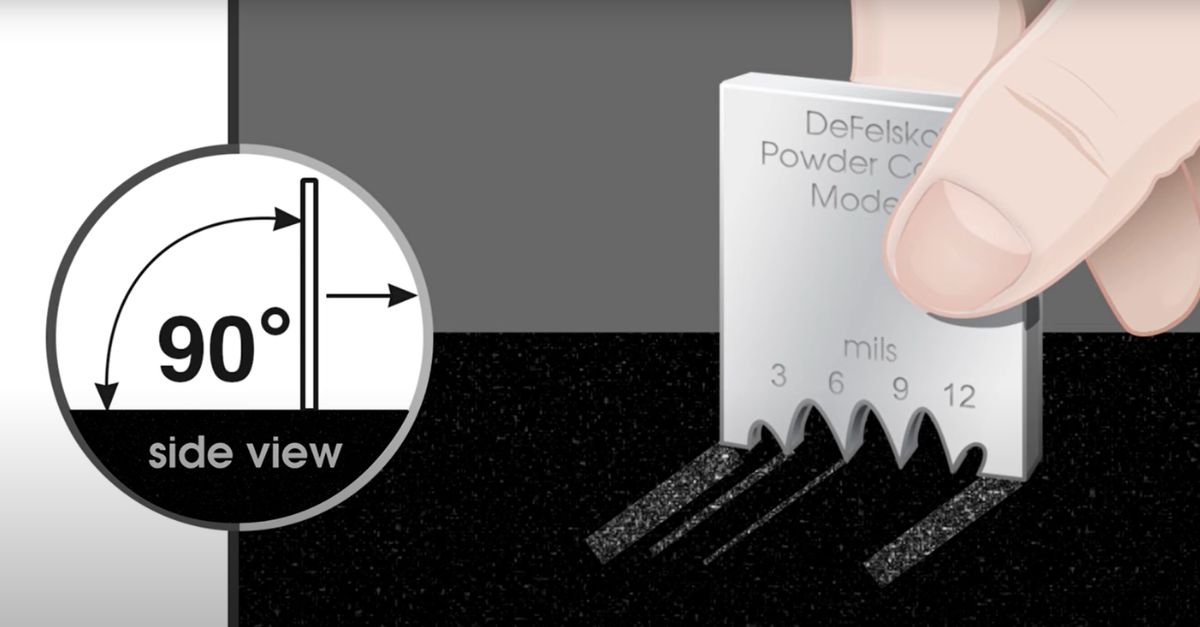
- Contact “comb gauges” – a simple and inexpensive but destructive method (it leaves a mark in the powder layer and requires recoating at the measurement point). It is not particularly suitable for measuring electrostatically applied powder coatings.
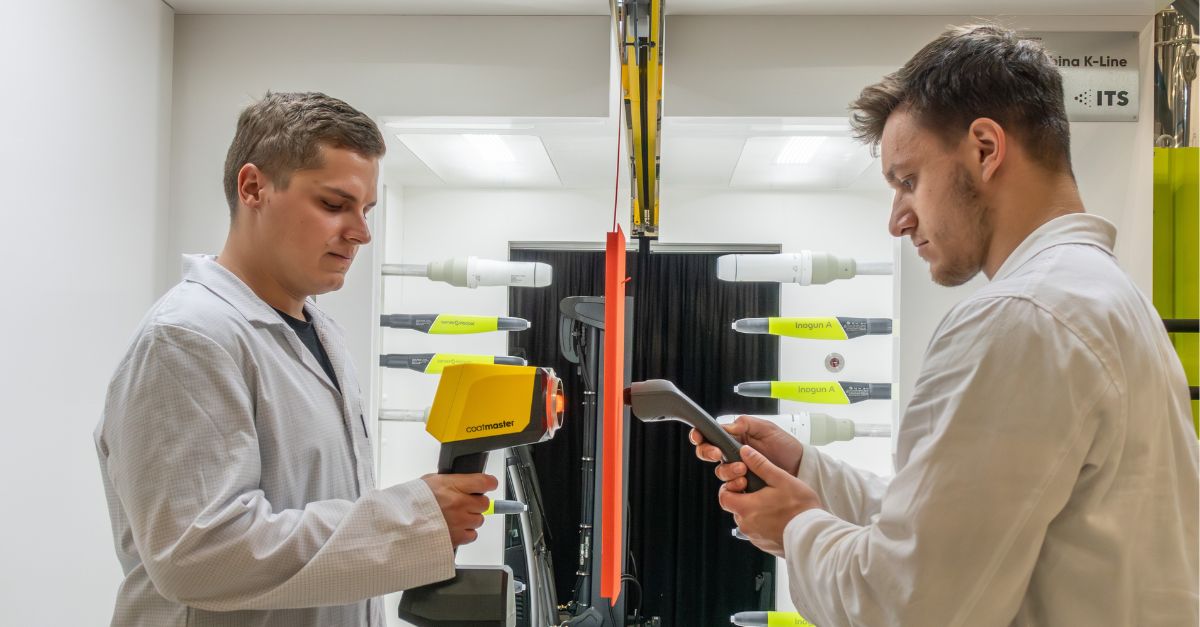
- Manual non-contact gauges – typically ultrasonic devices (such as PosiTest PC) or thermal-optical detection systems (such as Coatmaster Flex).
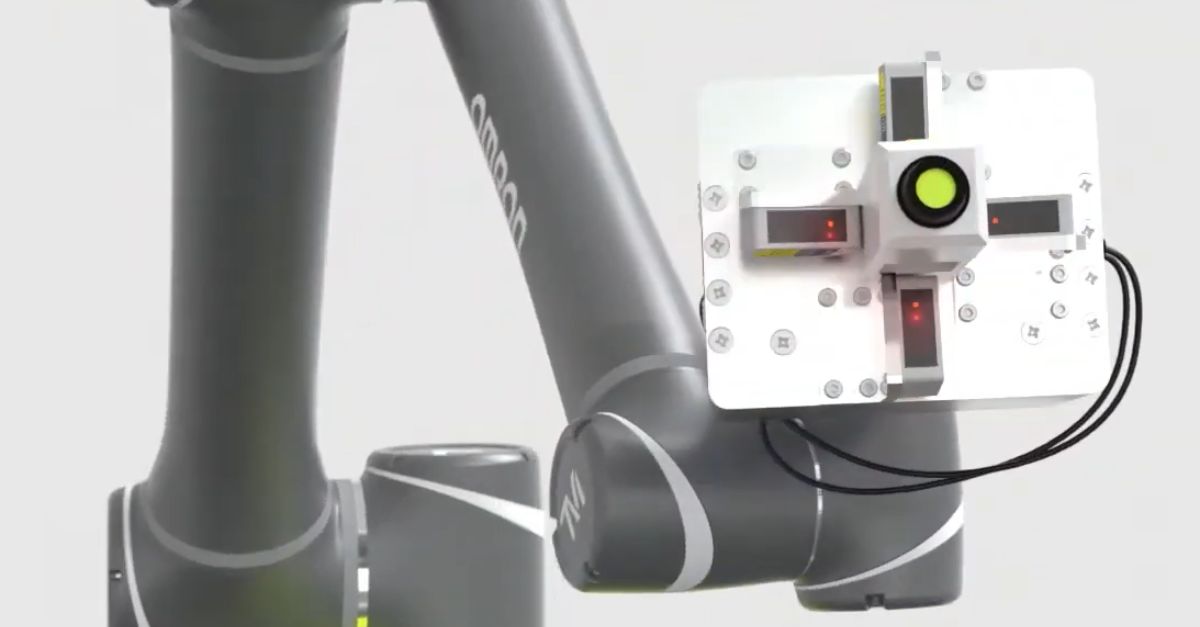
- Fully automated robotic and in-line systems – for example ArtiDeepControl, which measures directly on the line and automatically corrects the process.
Contact comb gauges may be mentioned for completeness, but from the perspective of a modern powder coating plant they are not a practical basis for efficient process control. The real benefit comes from non-contact technologies — either in the form of manual measurement or fully automated systems. In the following sections, we therefore present specific solutions from our portfolio that bring real practical value to coating operations.
PosiTest PC
PosiTest PC is a handheld non-contact instrument that uses ultrasound to measure the thickness of uncured powder coating and predict the cured thickness.
- range: 20–100 µm, resolution: 1 µm, accuracy: ±5 µm
- measurement time: 1–3 s, suitable even for slowly moving parts
- measuring distance: 19 mm
- for most powders, no complex calibration is required
- stores up to 999 readings, with averaging and data transfer to PosiSoft software
- Scan Mode enables continuous measurement
Typical applications in a coating shop:
- quick checking of line settings after a colour, product range or setup change
- verification of thickness at critical points (edges, recesses, complex parts)
PosiTest PC is particularly suitable where you need a simple, fast manual solution used mainly for indicative measurement — to determine whether there is “too little” or “too much” powder on the part.
Coatmaster Flex
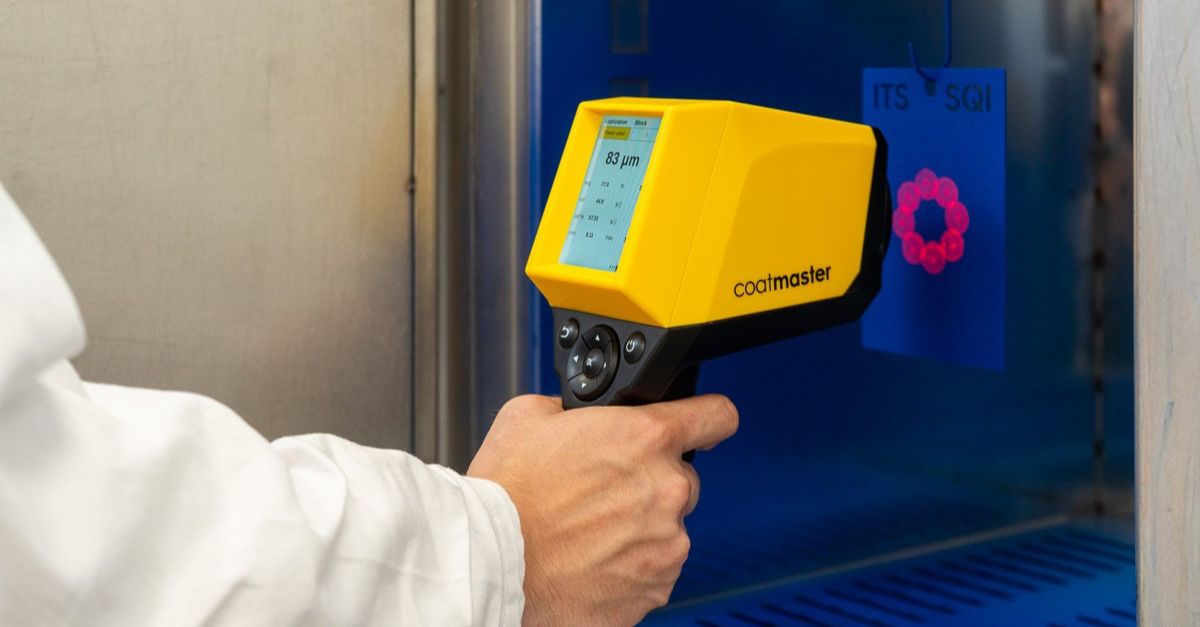
Coatmaster Flex uses Advanced Thermal Optics (ATO) technology. It briefly heats the powder coating surface with a controlled light pulse and evaluates the coating thickness based on the thermal response. The measurement is non-contact and non-destructive.
- measurement of powder and wet coatings before curing in a range of approx. 5–300 µm
- measurement of cured coatings in a range of approx. 5–500 µm
- measurement time from 20 ms — suitable even for moving parts on a conveyor
- absolute measuring distance: 2–15 cm; the instrument tolerates variations in distance and angle (up to ±70°)
- works with all colours, including white, on metallic substrates
- relative standard deviation <2% of thickness
- option for online data transfer to ERP systems, trend monitoring and statistical evaluation
Where Coatmaster Flex makes sense:
- coating plants with higher production volumes, where the speed and ergonomics of ultrasonic measurement may no longer be sufficient
- coating plants with lower repeatability in production, where each part and each colour may differ and where maintaining the required thickness can be more demanding
- operations that want to actively manage powder consumption and support the process with data
- situations where measurements must be taken on moving parts, including parts with difficult-to-access areas
Compared with ultrasonic measurement, this is a more advanced technological solution that works well as an intermediate step between manual measurement and a fully automated in-line system.
ArtiDeepControl
Where manual measurement no longer provides sufficient capacity, robotic systems come into play. ArtiDeepControl, developed by ITS, is designed for fully automated, non-contact measurement of powder coating thickness immediately after application and before curing.
- a measuring head is positioned behind the coating booth
- a robot or gantry system moves around the part
- measurements are repeated periodically at defined positions
- the system evaluates coating thickness and communicates feedback to the coating equipment
- the spray guns are automatically adjusted according to the measured data
Main advantages of ArtiDeepControl:
- non-contact measurement of uncured coating during full coating line operation
- automatic correction of part position — capable of handling parts with positional deviation
- flexible reach for geometrically complex products
- automatic calibration and high reliability
- ready for Industry 4.0 — integration into higher-level systems and data analytics
- savings in powder consumption
Compared with manual measurement, a robotic solution brings a fundamental change: thickness control is no longer random, but systematic and fully integrated into the process. Operators do not have to decide where to measure — the system always measures where it should, and at a frequency that makes sense for the given type of production.
What Level of Savings Can Realistically Be Expected?
The exact figures depend on the type of production, product mix, powder coatings used and the quality of the existing setup. However, industrial references show that:
- Coatmaster can reduce powder consumption by up to approximately 30% when optimisation is aimed toward the lower end of the prescribed thickness range
- in larger lines with high part throughput, ArtiDeepControl can deliver powder savings worth millions of CZK per year, not to mention the additional costs associated with rejects, complaints and extra labour
A typical scenario in practice:
Original setup:
- targeting a higher point within the thickness window “just to be safe”
- frequent overshooting above the upper limit
- random manual checks, rarely systematic
After implementing uncured coating measurement:
- reduced thickness variation
- target value shifted closer to the lower tolerance limit
- immediate response to any change in the coating process
- lower reject rates and less need to repeat the entire coating process
Even the transition to systematic pre-cure measurement alone is often enough to reduce powder consumption while improving quality at the same time. The selection of the right technology always depends on a combination of factors: production volume, part variability, required level of automation, available investment and expected return. Measuring uncured powder coating thickness is no longer a “nice to have” — in many operations, it is the only sensible way to keep both powder consumption and coating quality truly under control.
At SQI and ITS, we encounter the consequences of insufficient coating thickness control on a daily basis — from increased reject rates to costly claims. At the same time, we also see how introducing uncured coating measurement can dramatically reduce powder consumption and stabilise output quality within a relatively short time. If you are considering which uncured coating thickness measurement system makes the most sense for your coating plant, get in touch with us. We can help you:
- analyse your current process
- select the right technology
- calculate the real return on investment
Do you know anyone who might be interested?